Autistic Representation in Heated Rivalry: Nothing About Shane Needed Explaining
Heated Rivalry shows autism, intimacy, and desire without spectacle – and trusts the audience to notice.

Autism, without the courtesy of an explanation
Two weeks ago, I had the privilege of interviewing Rachel Reid, the author of Heated Rivalry. Afterward, I posted an Instagram Story about it, normally the kind of post maybe a hundred people see, and shared the same thought on TikTok. I didn’t think much of it.
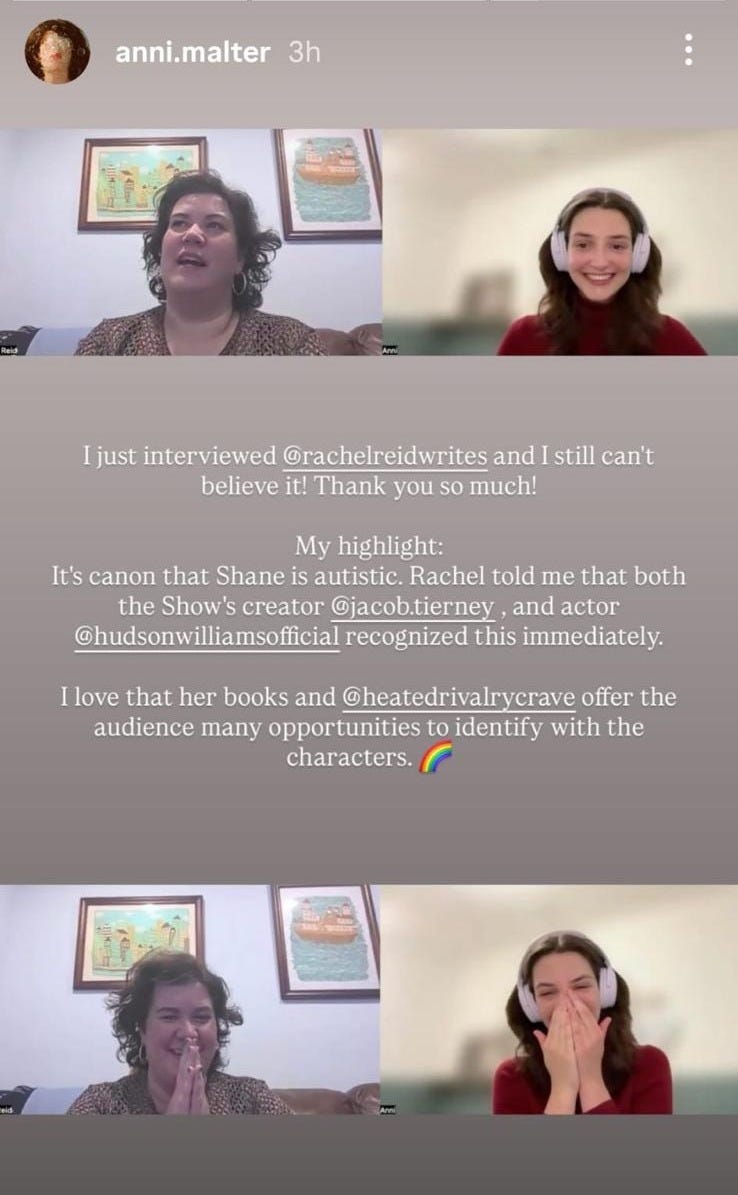
The core message was simple: I loved that show creator Jacob Tierney and actor Hudson Williams recognized Shane as autistic. For me, this wasn’t a revelation. Rachel herself had reaffirmed it on Reddit in November. I knew it while reading the books and seeing the first scenes of the show.
Which is ironic, in a way. I have virtually no social skills. I struggle to detect irony or sarcasm – often I miss it entirely. But when it comes to autism, my radar is flawless. I recognize neurodivergent people, real or fictional, as if I had an antenna that starts vibrating the moment it detects something familiar. It isn’t a checklist. It’s a feeling. A recognition that lives somewhere beneath language. Neurotypical people might find this hard to understand.
Autism, in popular culture, has long been flattened into a shorthand. But autistic people do not behave like Sheldon Cooper (who, incidentally, is not autistic). We are not a monolith. We are not a stereotype, despite decades of television and film insisting otherwise.
Autism is a spectrum. A neurodevelopmental condition. Not a “quirky trait.” Autistic women are not manic pixie dream girls. Autistic men are not walking punchlines built around rigidity or genius. Those caricatures may be easy to write, but they are easy precisely because they are false.
What Heated Rivalry understands – quietly, confidently – is that autism does not announce itself. It reveals itself in patterns, in pressure points, in the way a body moves through the world. And once you know what you’re looking for, you don’t need it explained.
That is precisely why Hudson Williams’s portrayal of Shane works so beautifully. His autism is not framed as a reveal, a problem, or a lesson. There is no diagnostic scene, no moment of narrative reassurance. Shane doesn’t even know it himself. And yet, within the first ten minutes of the first episode, it was unmistakable.
The body always gives it away
I was genuinely baffled when my story went viral – more so when I realized Jacob Tierney had seen it.
It surfaced on BuzzFeed Canada, circulated through pop-culture sites, and was eventually linked by GQ. What felt self-evident to me was apparently something many people were still arriving at for the first time.
But why? None of the news was new.
Shane takes things literally. (Ilya: “I thought you would chicken-out”, Shane’s response: “I’m not a chicken”) He avoids crowds. He has specific preferences around food and drinks. But more than that, his body tells the story: the way he moves, the way he clenches his hands into fists under stress, the way he manages physical closeness.
Hudson Williams captures all of it with remarkable precision. In later interviews, he spoke about drawing on personal experience, including his autistic father. Autism is a spectrum, of course – but Shane feels real: written with the quiet confidence of Rachel Reid, whose experience of having an autistic child shaped the character. The result is a character built from the inside out, not explained from the outside in.
Care without labels
I don’t need Shane to visit a doctor and receive a label. Shane already knows he is different. And so does Ilya.
What matters is not naming autism but responding to it. Ilya does. He adapts. He notices when Shane needs clarity, when ambiguity becomes distressing. Shane asks follow-up questions not because he’s difficult, but because he needs certainty to feel safe.
That dynamic gives their relationship a subtle, almost imperceptible dom-sub undertone – not as kink, but as care. Ilya understands how tightly wound Shane is, how much pressure he carries at all times. Shane isn’t just a team captain. He is one of the few Asian-Canadian players in a league built around whiteness. His mother reminds him that he carries responsibility. That he represents more than himself.
This pressure isn’t abstract. It’s racialized and relentless. Shane doesn’t get to be mediocre. Or reckless. Or visibly fragile.
What happens when flirting isn’t clear enough
Shane needs clarity. Not because he lacks feeling, but because feeling alone is not a language he can reliably read.
From the very first episode, Heated Rivalry establishes a quiet but crucial mismatch between Shane and Ilya: Ilya communicates through implication, gesture, escalation; Shane waits for information that is explicit, unambiguous, complete. This is not naïveté. It is autism. And the show treats it with remarkable precision.
Ilya tries, repeatedly, to make himself legible. In the gym, he flirts openly by most social standards: lingering looks, a challenging smile, casual questions about Montreal that are clearly meant to be invitations rather than small talk. Shane doesn’t register any of it as romantic intent. To him, it is conversation.
Ilya adjusts. He hands Shane his water bottle, encourages him to drink more, watches him closely in a way that signals care. He brushes his fingers against Shane’s, deliberately, testing whether touch might communicate what words haven’t. Shane notices the contact, but not the meaning. Physical proximity, without context, is not a message. It’s just sensation.
So Ilya becomes more obvious. He calls Shane “pretty” during the shoot. The word hangs there, nakedly affectionate. And still, Shane doesn’t respond. It’s easy to imagine why: compliments, especially from someone like Ilya, can read as teasing, exaggeration, performance. Without confirmation, Shane has no way of knowing whether the statement is sincere or ironic – and irony is a language he does not speak.
Ilya tries logic next. He tells Shane that the campaign was his idea. That he planned it. That he wanted Shane here. This, too, should mean something. But Shane doesn’t connect the dots. Wanting someone professionally is not the same as wanting them romantically. The information remains incomplete.
What follows is not seduction so much as desperation. Ilya runs out of subtext. Out of half-signals and plausible deniability. He chooses the one form of communication that cannot be misread: an overt sexual act performed openly, insistently, in Shane’s line of sight in the showers. It is, quite literally, the largest possible signpost.
And only then does Shane understand.
This moment is often read for shock or humor, but its emotional logic is exact. Shane does not require subtlety; he requires certainty. Once the message is explicit enough to eliminate ambiguity, he responds immediately. There is no hesitation, no confusion – only relief. Finally, the information is clear.
What Heated Rivalry gets right is that this is not about prudishness, repression, or slowness. Shane’s desire has been there all along. What he lacks is access to the unwritten rules that govern how desire is usually expressed. The show refuses to frame this as a deficit. Instead, it exposes how fragile and exclusionary “normal” neurotypical communication actually is – how much it relies on shared assumptions that not everyone has.
I had to watch the first episode several times to even understand what Ilya was trying to achieve here. Flirting doesn’t work for me either. Or more precisely: it only works when there are no riddles involved. Subtext, hints, playful escalation – none of that gets through to me. A pick-up line that would actually work on me would be something like this: “I like you. Here are the latest noise-canceling headphones. Would you like to sit next to me while you read books, play computer games, or build Lego Star Wars sets, while I won’t disturb or interrupt you?”
This is not a punchline, but an honest description of how closeness becomes understandable to me: through clarity, through consideration, through the offer of shared silence instead of performative intimacy. That’s exactly why Shane’s perspective resonated with me so immediately. What many viewers see as obvious courtship is, for him, and for me, initially just behavior. Only in retrospect, with distance and repetition, does it become clear how hard Ilya tried to be understood.
Precision as safety
In bed, Ilya gives directions, and is briefly surprised by how quickly Shane follows them. Shane takes what Ilya offers him and executes it with precision, almost studiously, as if clarity itself were a form of safety.
But this attentiveness runs both ways. Ilya is always paying attention. He notices when Shane tenses, when his breathing changes, when the moment threatens to tip from intensity into overwhelm. His emotional intelligence is not performative; it is practical. Immediate. He knows when to slow things down, when to ground Shane, when to pause entirely.
During their first penetrative sex, Ilya checks in repeatedly – even in the heat of the moment. Not out of uncertainty, but out of care. He wants Shane to feel safe. To know that stopping is always an option. That consent is not a single moment granted once, but a continuous conversation – one Shane doesn’t have to struggle to translate.
What emerges from this is not power, but trust. Ilya doesn’t want to change Shane. He wants to meet him exactly where he is – and stay there with him.
One man drowns himself in noise, the other in silence
Ilya’s background is the inverse: a mother lost to suicide, a tyrannical father slowly disappearing into dementia, a brother who treats him like an ATM. He lives in a foreign country, in a borrowed language, always slightly unmoored. He manages pressure through excess: parties, one-night stands, expensive cars. Hockey isn’t sacred to him; he is simply good at it. Noise is how he survives.
Shane moves in the opposite direction. He withdraws. He has to be coaxed into going out, and even then he often disappears early, retreating under polite excuses when a situation becomes too much. While Ilya parties on vacation, Shane reads in bed or fulfills obligations quietly assigned to him – photo shoots, sponsorships, advertising campaigns, carefully managed by his mother. Where Ilya externalizes stress, Shane absorbs it, carrying pressure inward until silence feels safer than spectacle.
And yet, Shane is the one who unsettles Ilya’s carefully curated excess. He makes him want something else. Someone to beat. Someone to measure himself against. They push each other toward excellence on opposing teams, while sharing beds, showers, staircases, couches – whatever space time allows. One drowns himself in noise, the other in silence, and somehow they keep meeting in the narrow space in between.
“Boring” is the fantasy
Ilya calls Shane boring. What he means is: safe. Predictable. Quiet.
Boredom, for Ilya, is a fantasy of rest – a life not fueled by spectacle or conquest. That’s why it hurts so much that Shane doesn’t understand what he’s offering.
Ilya opens himself. He buys ginger ale just for Shane. He reaches out in the small ways that matter.
Shane doesn’t see it.
He notices the gestures, but not the intention behind them. Too much new information presses in at once. How is he supposed to respond? They have never spoken about personal things before.
When subtext is a foreign language
When Ilya talks about Svetlana, about sleeping with women, Shane misses the intention entirely. He doesn’t read it as an invitation, as a way of saying: You’re safe with me. You can talk about this. Ilya is trying to open a door. To make space for Shane to speak about his own sexuality. Shane hears only the words, not the gesture behind them.
When Ilya lets Shane’s first name slip, the system overloads. Too much information arrives at once, with no way to order it. Shane panics. He runs.
Ilya is left confused, and hurt – especially when, shortly after, Shane appears on gossip magazine covers with Rose Landry. The same Shane who had insisted he was a private person. To Ilya, it feels like a contradiction at best, a betrayal at worst. What does Shane want? And what does Ilya want, if he keeps surrounding himself with women, if he keeps calling Shane “boring,” as though that were a flaw rather than a longing?
The club scene is not (just) about music
Then comes the club. The remix. (Yes – that remix.) Their shared looks.
Shane wants to prove that the sharp pain in his chest has nothing to do with Ilya. It does. Of course it does. And Ilya feels the same.
Shane goes home with Rose. She undresses with the kind of practiced confidence that usually reads as desire on screen. Shane’s face tells a different story. Desire is notably absent. He looks less like someone making love than someone fulfilling an obligation – not intimacy, but duty, performed with a beautiful Hollywood actress.
Btw, autistic people are statistically more likely to be queer than neurotypical people. I can confirm that. Maybe because heteronormativity already feels arbitrary. Maybe because social scripts rarely make sense to us anyway.
Maybe Shane is demisexual. The book suggests that intimacy with other men did not work for him. He needs Ilya – not a man, not a body, but him.
Almost the end
In “I’ll Believe in Anything”, the dynamic shifts. This time, it is Ilya who is unsure. Who makes himself vulnerable. Who spirals at the thought that Shane could still be with Rose. Now it is Ilya who asks the follow-up questions. Who needs reassurance spelled out clearly. Who needs confirmation – again and again.
The balance tilts. And for the first time, it is Ilya who stands exposed, wondering whether what he felt was mutual at all.
When they sit together on the beach as the sun goes down, it feels as if the years-long situationship finally exhales. Something loosens. For the first time, they open up at the same time. They stop talking past each other. They learn – haltingly, imperfectly – how to communicate. Well, slowly.
Ilya opens up, makes himself emotionally naked. He cries. And Shane is there. He catches him. Holds him. Listens. When they part, it is tender, not dramatic, a goodbye shaped by care rather than confusion.
Then comes Shane’s accident. And with it, Ilya’s emotional unraveling. He has barely buried his father, when the possibility of losing Shane crashes into him. The timing is cruel. The grief stacks. Ilya had meant to end things, to protect himself by walking away.
Instead, Shane invites him to the cottage.
Ilya can only manage a “maybe.”
And then – the world shifts. When they see Scott and Kip kiss on the ice, it is Ilya who calls Shane. No greeting. No small talk. Just the truth, finally spoken without hedging.
“I’m coming to the cottage.”
Planning is how Shane loves
In the finale, Shane follows a recipe exactly, without considering how many people it’s meant to feed. He doesn’t stop to think that it’s just him and Ilya. The recipe calls for eight burgers, so he makes eight burgers. Structure isn’t rigidity; it’s devotion. It’s choosing reliability in a world that often feels overwhelming. Love, here, is careful, methodical, and complete. I watched it with a jolt of recognition. I’ve cooked that way, too, faithful to the instructions, trusting the structure more than the context. Because context is slippery. Reality shifts. Social situations come with rules that are implied, inconsistent, and endlessly renegotiated. You can follow them perfectly and still be wrong.
Recipes are different. Cooking and baking offer something society rarely does: clarity. Fixed steps. Predictable outcomes. If you follow the instructions, you get what you were promised. In a world where even strict adherence to “social rules” never guarantees understanding or safety, structure becomes not a limitation, but a refuge.
Shane and Ilya savor the time. Two uninterrupted weeks together. Earlier in the show, Shane mentions that he only gets two weeks of vacation a year – and now he wants to spend them with Ilya. They play video games and soccer. They cook. They have sex. They share clothes. Shane and Ilya exist side by side in the quiet intimacy of shared routines. It’s domestic. It’s a real relationship.
And yet, Shane still doesn’t seem to grasp that Ilya is, in his own way, proposing to Shane. Ilya talks about giving up his Russian passport. About moving to Canada. And then later, almost offhandedly, about marrying Svetlana. Because it’s practical. Because she’s his childhood friend.
Shane is devastated. He begs him not to do it – tears in his eyes, completely undone by the idea that Ilya could even consider marrying Svetlana. It never occurs to him that Ilya might be talking about him. Instead, Shane lies awake, constructing a plan that stretches years into the future, a careful strategy designed to secure a life together without ever having to say the words out loud.
This is how Shane loves: methodically. Privately. Completely.
Staying calm is how Ilya loves
When Ilya finally says the words “I love you” out loud, Shane is stunned. He can’t believe it, despite all the small and large signals Ilya has been leaving along the way. Ilya is visibly emotional, his voice breaking, tears in his eyes. For a moment, he tries to backtrack, overwhelmed by the vulnerability of having said it aloud.
Shane answers almost automatically. His response comes out rational, measured, as if delivered by instinct rather than impulse. Not because the feeling is weaker, but because he has been waiting, for years, for this exact thing: a clear, precise statement, finally spoken without ambiguity. Once the words are there, once the information is complete, Shane knows what to do with it.
It’s a familiar pattern for many autistic people: implication doesn’t always land. Meaning often needs to be spoken plainly, not because the feeling isn’t there, but because ambiguity creates too much room for error. Clarity is not a lack of romance; it is a form of care.
When my best friend told me she was engaged, the conversation went something like this: “He asked me!” And I remember being completely confused. “Asked you what?”
What seems obvious from the outside often isn’t on the inside – at least not until someone says it out loud.
Throughout the final episode, Shane fidgets, clenches, self-soothes. He has two panic attacks. And Ilya stays calm. He lets Shane decide how much touch he can handle. He creates space for him to fall apart safely.
Care, here, is not loud. It’s precise. Ilya’s love for Shane expresses itself in actions: in playfulness, in gentle grounding, in moments that loosen Shane’s grip on himself without ever asking him to change. Ilya doesn’t manage Shane; he meets him where he is.
That tenderness has been there from the beginning. The first time Shane undresses in front of Ilya, he folds his clothes neatly, methodically. Ilya is delighted – not condescending. He doesn’t tease in a mean way. He doesn’t correct. He simply takes Shane as he is.
Love, in this relationship, is not about fixing. It is about recognition.
Two loving parents
Shane doesn’t circle the subject. He speaks calmly, simply, stating the facts as they are: that he is gay, and that he loves Ilya. There is no performance in the confession, no attempt to soften or dramatize it – just clarity.
There is something quietly important about how Shane’s parents react. They are not shocked that he is gay; they had suspected it already. What unsettles them is not his queerness, but the identity of the man he loves – Ilya, his rival on the ice, a name they have heard for years in an entirely different context.
Yuna voices it plainly: “But… you hate him?”
And even that shock passes quickly.
What remains is openness. Curiosity. Love. They ask questions. They listen and are quietly shocked when they realize how long Shane and Ilya have already been “together.” They adjust. David, genuinely puzzled, wonders aloud: “And there were no nice men in Montreal?”
Watching that scene, I found myself wishing, simply and without irony, that this is how every coming out should go. Not dramatic. Not traumatic. Just met with the assumption that love is not something you have to earn by being palatable, successful, or normal.
What remains central throughout the scene, however, is Shane’s constant effort to regulate himself. His hands are not buried in his pockets; instead, he grips the edges of them, fingers tightening around the fabric as if holding himself in place, as if to steady himself. Eye contact functions just as sparingly. Shane cannot hold a gaze for more than a heartbeat before his eyes drift away. The acceptance is real, but his body still bears the imprint of vigilance. Even here, even now, staying present requires work.
What I love about Heated Rivalry is that Shane’s autism is never framed as a lesson. It is never named, solved, or overcome.
It simply exists.
And that, more than any speech, diagnosis, or declaration, is what makes it radical.
Difference without diagnosis
Shane already knows he is different. And so does Ilya. What matters is not the name for that difference, but the way it is met – with patience, with curiosity, with care.
The emotional peak comes in a quiet conversation with his mother. Shane tells her that he tried – really tried – for a long time to be normal. That he wanted it to work. That he wanted to fit. But that he can’t.
The line is never clarified, and that is its power. It can be read as a coming-out, or as an admission of neurodivergence, or as both at once. Shane does not know that he is neurodivergent – but he knows that he is different. He has always known.
The show understands this distinction. It refuses diagnostic language not out of vagueness, but out of respect. Shane’s experience is not defined by terminology, but by the lifelong effort of trying to be legible in a world that was not built for him.
Care without urgency
Shane’s autism surfaces once more in his second panic attack. Everything becomes too much at once: the conversation about their future, the planning, the expectations layered on top of one another. He withdraws physically, folding in on himself, burying his head on the table. His parents look loving, but unsure what to do with the moment unfolding in front of them.
Ilya reacts differently.
Just moments earlier, he had been calmly eating his spaghetti while Yuna talked about marketing plans. Now he remains just as steady. He doesn’t rush. He doesn’t dramatize. He brings back the quiet Shane needs by doing the simplest thing: he tells the truth.
That everything is okay.
That his family is here.
And that his boyfriend is here.
Boyfriend.
Shane looks up. Earlier, he had visibly flinched and was grossed out by the word lover. But Ilya’s casual certainty – his refusal to make the word heavy or charged – cuts through the panic. It grounds Shane. It brings him back.
Ilya kisses him in front of his parents without hesitation, without performance. He doesn’t look at them. He doesn’t check for permission. His attention never leaves Shane.
In that moment, love is not loud or symbolic. It is focused. Protective. Utterly uncomplicated.
And Shane, finally, can breathe again.
It landed because we recognized ourselves
I was surprised by how many people reacted to my story. For me, Shane’s autism was obvious. Rachel Reid had already confirmed it publicly back in November, but the confirmation went largely unnoticed. The series hadn’t been released yet.
My inbox filled with messages from people who felt relieved – relieved that Shane’s autism was canon, relieved that what they had recognized in him wasn’t imagined or projected. Again and again, people wrote that it mattered to see themselves reflected so clearly, and so gently. That for once, the representation felt accurate.
Not inspirational.
Not tragic.
Just real.
I understood that immediately. I felt the same way when I first read the books. There was a quiet joy in recognition – followed later by an unexpected one: connecting with so many people online, hearing their stories, seeing how deeply Shane had resonated across different lives and experiences.
The series already offers queer representation within professional hockey – a sport long defined by toxic masculinity and still without an openly queer active player. It weaves in an immigrant narrative through Ilya, and a racialized experience through Shane. His autism doesn’t compete with those layers; it deepens them.
Maybe that’s why the story landed so hard.
Not because it said something new.
But because it trusted us to finally see it.
Loved this so much! Shane is such a precious peanut & Ilya is such a fantastic rock for him. When Shane says this is his worst nightmare & Ilya immediately responding, "then maybe it's time to wake up, yes?" was so validating. He's acknowledging Shane's emotions but also reminding him he's strong and he can get through it.
I loved the article! It’s so accurate and explicits so well what I’ve thought and noticed while watching the series! It also gave me more insight on the mechanics of the representation, what makes it so good. I truly hope we’ll have more like this in the future !